A Timeline Before a Turning Point
Build a timeline before calling an event a turning point: place developments in order, mark gaps and judge whether the label fits the wider context.
The most common mistake in calling an event a turning point is to treat the label as a settled description. That can make a messy, gradual shift look like a clean break and hide the other developments that shaped it. A timeline before a turning point helps you judge whether the story’s chosen moment really marks a change in direction.
Use one when a current-affairs story calls an election, court ruling, protest, policy change, military action or resignation the moment that changed everything. The task is not to prove the label right or wrong. It is to see how the event fits the wider sequence and whether the account shows what changed, for whom and over what period.
What exactly is being called a turning point?
Start with the story’s wording. Note the event described as the turning point, then identify the claimed change: a policy was adopted, an organisation shifted direction, a conflict entered a new phase or public debate took a different course. “A turning point” without a stated outcome is too vague to assess.
Choose a manageable question. Instead of asking whether an event changed “the country”, ask whether a named decision followed, a stated position changed or a particular process entered a new phase. A focused question helps you decide which entries belong and which are merely nearby events.
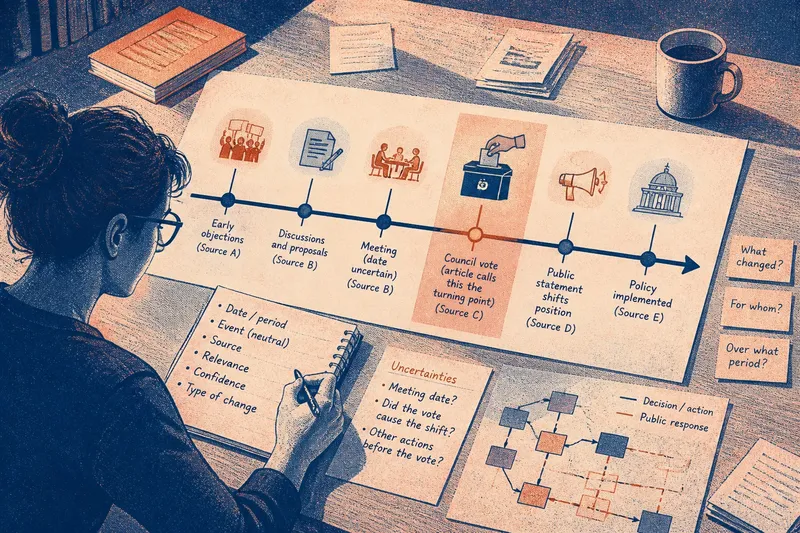
Keep the label attached to its source. Write “the article calls the vote a turning point” rather than adding that description to your timeline as a neutral fact. The distinction matters because a label is an interpretation; the timeline should first record what happened.
How far back should the timeline go?
Work backwards from the event, looking for developments relevant to the change in question: earlier decisions, public statements, negotiations, disputes, rule changes or actions by the people involved. Include multiple strands if the story touches several parts of an issue.
You do not need a complete history. Start with enough context to show whether the event emerged from an ongoing process or marked a distinct shift. If the report describes a long-running dispute, include earlier stages. If it describes a policy change, include the discussions and decisions that preceded it.
Expand the period if your first draft makes the event seem to appear from nowhere. Narrow it if the timeline fills with unrelated background. Each entry should clarify the question you are asking or help explain the situation in which the event occurred.
How do you build a useful timeline?
Use a table, spreadsheet or a line on paper. Give each entry a date or period, a neutral description of the event and its source. Keep the wording short enough to avoid blending an interpretation into the event itself.
Sort entries by when the events happened, not when reports about them appeared. A document may be published after it takes effect; a meeting may be reported days after it took place. Note both dates when the difference affects the sequence.
Use only the degree of precision the source supports. Write “early in the month” or “date unclear” rather than assigning an exact day without support. If two events may overlap, record that uncertainty instead of forcing them into a tidy order.
- Date or period: Check the timing given by the source; if it is specific and supported, record it, but if it is vague or disputed, mark the uncertainty and avoid a precise date.
- Event: Check whether the entry describes an observable action or decision; if so, record it neutrally, but if it is an interpretation, label it as a claim or leave it out of the event column.
- Source: Check where the detail comes from; if the source is identifiable, cite it in your notes, but if it is unclear, mark the entry as unverified and seek a clearer account before relying on it.
- Relevance: Check how the event relates to your question; if it helps explain the claimed change, include it, but if it adds no useful context, omit it from the working timeline.
- Confidence: Check whether accounts agree on the detail; if they do, record the shared point, but if they conflict, preserve both versions and leave the disputed point open.
- Type of change: Check whether the story describes a proposal, a decision or an action already in effect; if the status is clear, label it accurately, but if not, mark the status as uncertain and avoid treating a proposal as a completed change.
Say you are reading a report that calls a council vote the turning point in a dispute. Imagine the starting information is a set of notes describing earlier objections, a delayed meeting, the vote and a later shift in the council’s public position. You sort those entries by event date, note the report that supports each one, and mark the meeting date as uncertain because the account does not specify it. The resulting timeline shows that objections predated the vote and that the public position shifted later, while leaving open whether the vote caused that shift.
How can a timeline show a real change?
Look for the before-and-after pattern the label implies. Did a policy move from proposal to implementation? Did an organisation change its stated position? Did a dispute move from negotiation to formal action? Naming the observable difference makes “turning point” more than a dramatic flourish.
Check who experienced the change. A decision may alter the choices available to one group while leaving another’s situation much the same. A story that describes a turning point for an institution may not be describing a turning point for everyone affected.
Also look for continuity. The event may have made an existing direction more visible, accelerated a process already under way or changed one part of a wider situation. Those possibilities do not make the event insignificant; they help describe its role more precisely.
What details can change the picture?
Check timing and wording against the material the story cites. A document may be dated when it was released rather than when it took effect. A statement may announce a proposal, not a completed decision. A report may call an action “the first” without showing whether related actions came earlier.
Separate an event from an assessment of its impact. “The minister announced a review” describes an event. “The announcement ended the dispute” describes an outcome that needs support. If you include the latter, note what observable change would make it accurate, such as a formal resolution or a party withdrawing its objection.
Keep disagreements visible. If one account places a meeting before an announcement and another gives no meeting date, record both. If that uncertainty affects whether the event was a break with the past, do not smooth it away for the sake of a neat story.
What if the timeline is incomplete?
Leave gaps marked. Current-affairs coverage can develop while events are still unfolding, and an incomplete sequence is better than one filled with plausible guesses. Add “unclear” beside a disputed point and note what information could resolve it.
Distinguish missing coverage from evidence that something did not happen. If the reports you have seen do not mention a conversation, you can say the available timeline does not show one. You cannot conclude from silence alone that no conversation took place.
Revisit the sequence when a dated record, fuller account or clearer statement of when a change took effect becomes available. The point is not to make the timeline look complete; it is to keep its limits visible.
What questions help assess a turning-point timeline?
How many events should a timeline include?
Include events that help assess the particular change under discussion, rather than every event in the surrounding period. Add context when it changes how the event’s place in the story appears.
Should I include events after the turning point?
Yes, if they show what changed or how the claimed shift unfolded. Record them as later developments, without letting their position in the sequence settle the label by itself.
What if reports give different dates?
Record each account’s date and identify its source. If the disagreement changes the order or significance of events, leave that part unresolved until a sound basis for clarification appears.
Can a timeline show that an event was not a turning point?
It can complicate the label by revealing earlier changes, continuing patterns or different experiences of the event. The timeline helps describe the context; it cannot settle every judgement about significance on its own.
How should you use the timeline when reading the story?
Compare your sequence with the article’s framing. Does the story begin at the same point? Does it mention earlier stages of the change or make a gradual process sound sudden? Does it describe the event as a major shift for everyone when the reported effects apply only to some people?
Try a careful counterfactual as a reading prompt: if the highlighted event were removed, what other developments would still help explain the later situation? The answer might be an earlier agreement, a planned decision or a change already under way. Treat it as a question to examine, not a conclusion about what would have happened.
You can then write a measured assessment: “The vote coincided with a change in the council’s stated position; the timeline does not show whether that change was lasting.” Or, if the reporting describes a specific institutional shift, name that shift and the people or organisations it affected. A timeline before a turning point is useful when it makes the label more exact, not merely more dramatic.
Even an event that marks a genuine break may not explain everything that follows. Keep the turning-point label tied to the particular change the account supports, and let the wider sequence show what else was already in motion.