Following a Quote Back to Its First Appearance
Following a quote to its first appearance helps you see what changed between an original document, a recorded remark and the summary in a news story.
The common mistake is to treat a quotation repeated across several news stories as though each repetition independently confirms it. Following a quote to its first appearance can reveal that those stories all lead back to one short statement—and that the wording around it changed as it travelled.
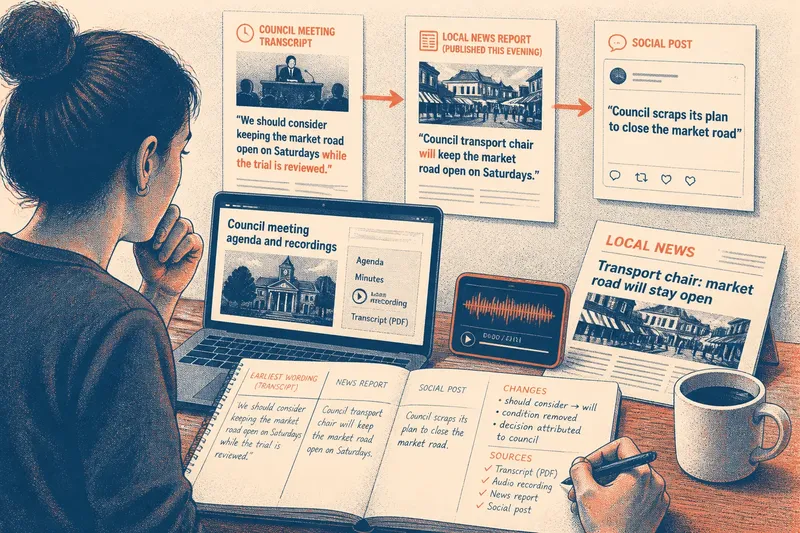
Imagine a clearly hypothetical situation: a town council’s transport chair says at a public meeting, “We should consider keeping the market road open on Saturdays.” By evening, a local news site reports that the chair “will keep the market road open”. A social post turns that into “Council scraps its plan to close the market road”. The subject is the same; the commitment is not. Trace the versions in order, and the difference becomes visible.
Where does the trail begin?
Start with the earliest item you can locate, not the most polished or widely shared version. Search the distinctive words in quotation marks, then try a shorter phrase without punctuation. Search results can surface a press release, meeting agenda, transcript, video, or a report that names the source. Record the page title, publisher, date and link as you go.
In the invented council case, the first useful result might be the news site’s report. Its wording is not yet the source: it is a clue. Look for a link to the council meeting, a cited recording, or a transcript. If the report says “according to the chair’s statement”, search the council site for that phrase and the meeting date.
Keep a simple trail in your notes: what you found, where it points, and what remains unavailable. A later article can be useful for finding a document, but its publication date alone does not tell you when the words were first spoken or written.
Which source can establish the wording?
Different sources preserve different things. An original document can establish the text that was published, but not necessarily what a person said aloud. A recording lets you hear spoken words and, sometimes, the question or exchange that prompted them. A transcript is easier to search, though it may omit pauses, interruptions or surrounding remarks.
For the hypothetical meeting, an official transcript might read, “We should consider keeping the market road open on Saturdays while the trial is reviewed.” A recording could confirm that wording and reveal that the chair was answering a question about a temporary arrangement. The phrase “while the trial is reviewed” matters: the news report’s shorter quotation leaves out its condition.
Use the source that fits the question. To check the wording of a written statement, find the statement itself. To check what was said, seek the recording or a transcript tied to it. If no primary material is available, say that your trail ends at a secondary account rather than presenting that account as the original.
What changed as the quote travelled?
Compare versions word by word, then examine the sentence around each one. Watch for small edits with large effects:
- Modal verbs: “might”, “should” and “will” signal different levels of commitment.
- Conditions: a phrase such as “during the review” can limit how long a proposal applies.
- Attribution: “the chair said” is different from “the council decided”.
- Scope: “consider keeping” describes an option, not a settled policy.
- Surrounding exchange: a reply may address a narrow question rather than announce a general position.
In this invented case, the first shift is from “should consider” to “will”. The second drops the review condition. The social post then assigns the decision to the council as a whole, although the quoted words belong to one chair. None of those changes requires an outright fabricated sentence; together, they make the statement sound final.
Make a side-by-side note of the earliest wording and each later version. Mark additions, omissions and substitutions, but keep the original sentences intact in your notes so that your comparison does not become another compressed retelling.
How should you judge a quote trail?
A source trail is only as clear as its links. A report may quote a document that has since moved, refer to an unnamed briefing, or rely on a transcript that does not identify who prepared it. Note those limits. A missing link is not proof that a quotation is false; it does mean you cannot verify it from that trail alone.
Also distinguish a first appearance you can locate from the first appearance that ever existed. Search engines may miss deleted pages, printed material, private messages or older versions of a webpage. If an archive shows an earlier version, compare its timestamp and text with the current page, and be cautious about treating a displayed date as the moment the words were first created.
For the council story, a careful account might say: the recording contains the chair’s qualified suggestion; the local report shortens it and changes “should consider” to “will”; the social post describes a council decision that the available material does not establish. That wording tells readers what the sources support without pretending the trail is complete.
What do readers often ask about tracing a quote?
What counts as a primary source for a quotation?
For written words, it is usually the original document or statement. For spoken words, a recording is direct evidence of what is audible, while a transcript can help locate and inspect the passage.
Is the earliest search result the original?
Not necessarily. Search rankings are not a chronological record, and an older source may be unindexed or unavailable. Follow the links and citations, then describe the earliest version you actually found.
What if the recording and transcript differ?
Check whether the transcript identifies its publisher and whether it marks edits or interruptions. Quote the recording’s audible wording where you can verify it, and describe any discrepancy rather than silently choosing the more convenient version.
How much surrounding material should I check?
Read or listen far enough to identify the question, condition and speaker’s immediate point. More context can matter, but the relevant boundary is the exchange that changes what the quotation means—not an arbitrary amount of material.
What should you carry forward?
Following a quote to its first appearance is less about catching a dramatic deception than preserving distinctions: spoken versus written, suggestion versus decision, and complete wording versus edited excerpt. Those distinctions are useful even when every outlet appears to be quoting the same person.
In the hypothetical transport story, the result is not a claim that the road will stay open or close. It is a precise account of what the chair said, what the report changed, and what the available record cannot settle. When you share the story, include the primary link where possible and identify any wording difference in plain language; readers can then inspect the same trail for themselves.