The Small Crop That Changes a Photograph
Learn how a photograph’s crop steers attention, and describe what it shows without treating the unseen area beyond its edges as established fact.
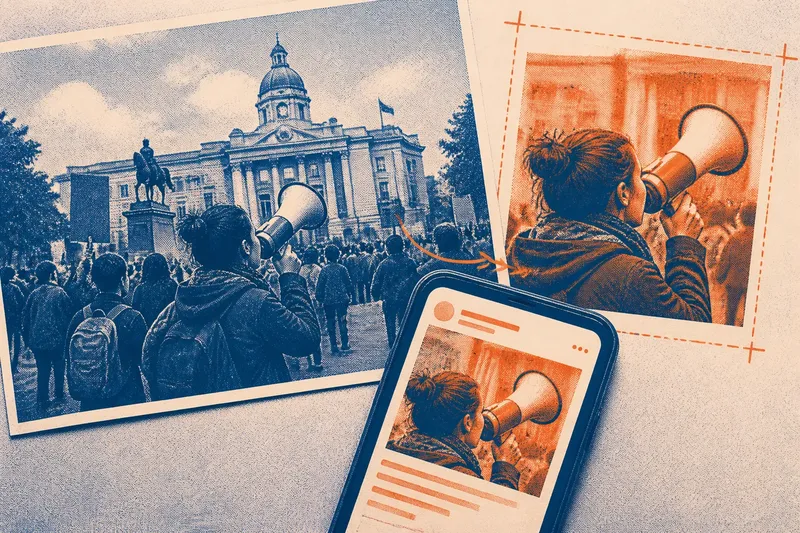
The common mistake with a news photograph is to treat its edges as the edges of the event. A tight crop can make one face, gesture or damaged object dominate the account, while leaving nearby people and surroundings out of view. The result is not necessarily a false image; it is a partial one, and the crop can shape what a reader thinks happened.
Photograph framing is the boundary between what an image shows and what it leaves unseen. When a picture circulates in a news story, on a social feed or as a screenshot, that boundary may be editorial, practical or simply inherited from an earlier version. The useful question is not only “What am I looking at?” but “What does this framing let me see, and what does it not establish?”
Are you looking at a tight crop?
A tight crop cuts close to the subject: perhaps a person’s raised hand, a row of police shields or a damaged doorway. It can make a visual detail easier to inspect, but it also removes information about distance, scale, nearby people and the surrounding scene.
Use this approach when the story’s point concerns a visible detail and the crop does not appear to be doing the work of an argument. Describe the detail precisely, then keep the claim proportionate: “The cropped image shows a person holding a sign” is stronger than “The crowd is protesting”, unless the image itself shows enough of a crowd to support that description.
Be especially cautious when a crop turns a relationship into a conclusion. A person standing beside an official is visible; whether they are speaking together, confronting one another or simply sharing a space may not be.
Say what the crop makes easy to notice, then identify what it hides from view.
Is the wider scene visible?
A wider photograph may include more of the location, nearby people and the arrangement of objects. That extra context can help readers judge whether a close crop has omitted something relevant. Yet a wide view is still a frame. It has an edge, a viewpoint and a moment of capture; it cannot show every direction or what happened before or after the shutter clicked.
This situation suits a cautious description of visible relationships. You might note that several people are gathered around a vehicle, or that a barrier separates the foreground from a building. Avoid treating a wider composition as a complete account of the event. More visible surroundings reduce some uncertainties, but they do not answer questions outside the photograph.
Compare the wider view with the version used in the story if both are available. Ask what has been added or removed, and whether that change alters the subject’s apparent size, position or relation to others. The comparison is about framing, not a shortcut to deciding motive.
Did you see the image only as a screenshot?
A screenshot may crop the photograph itself, or it may show a cropped post containing a photograph. It can also conceal a caption, credit, date, source link or surrounding text that helps explain how the image is being presented. A screenshot is therefore evidence of what appeared in that captured view, not automatically a complete copy of the original image or its publication context.
This approach fits when an image arrives detached from a recognisable news page: in a message, a repost or a cropped social post. Before drawing a conclusion, look for the same photograph on the outlet’s own page or in a fuller post. Compare the edges and caption, and note any differences without assuming that one version is deceptive.
If the original cannot be located, say so in your description. “A screenshot shows a cropped photograph of a street” reports what is available; “This photograph proves what happened at the scene” claims more than the screenshot can carry.
Does the caption make a claim the image cannot settle?
Captions can identify a place, date, person or event, and that information may be essential to understanding the photograph. But a caption is also part of the framing. It directs attention and supplies an interpretation; the visible pixels do not independently verify every detail written beneath them.
Use the image for what it can directly support: visible clothing, objects, posture, setting and spatial relationships. Treat claims about identity, intention, cause or sequence as claims that need context beyond appearance. A photograph of smoke, for example, can show smoke; by itself it may not establish its source or why it began.
When the caption and image seem to pull in different directions, describe both separately. You can say what the caption asserts and what the photograph visibly contains without quietly merging the two into one fact.
How should you describe what the crop shows?
A useful description separates observation from inference. Start with concrete nouns and verbs: “A person in a dark coat stands beside a barrier.” Then mark uncertainty where the image leaves it: “The crop does not show who is on the other side.” This phrasing is not evasive. It gives readers a clear account of the evidence and its limit.
Imagine you see a tightly framed image of a hand touching a window, with a caption calling the gesture a protest. You can describe the hand, the glass and the crop, then say the image alone does not establish the person’s purpose or what is happening outside the frame. That leaves room for the caption’s claim to be checked without presenting it as something the photograph proves.
When you write or discuss a photograph, ask yourself:
- What objects, people and actions are plainly visible?
- Which edges cut off a person, object or part of the setting?
- Does the crop make one subject appear isolated, central or unusually large?
- Is a caption supplying identity, motive, location or timing that the image cannot show on its own?
- Can you find a wider or less cropped version, and does it change the visible relationships?
- What wording would distinguish an observation from an interpretation?
The decision after each question is simple: keep what you can see in the description, and qualify what depends on missing context.
What questions help when the edges are unclear?
Can a photograph show what happened just outside its frame?
No. It can offer clues about the visible scene, but the excluded area remains unseen. Describe any clue as a clue, not as direct proof of what was beyond the boundary.
Does a tighter crop mean the photograph is misleading?
Not by itself. A close crop may be used to focus on a relevant detail, but it can also remove context that would alter a reader’s impression. Compare versions where possible and explain what each one includes.
How can I tell whether the image has been cropped?
Look for a version with more surrounding detail from the same source, and compare the subject’s position and the scene’s edges. If no fuller version is available, avoid claiming to know how much was removed.
What is the safest way to caption an uncertain image?
Name the visible subject and action, then state the relevant limit in plain language. Keep attribution or interpretation separate from what the image itself shows.
What fits when no wider version appears?
Sometimes the fuller photograph is unavailable, or different versions circulate without enough information to establish how they relate. In that situation, do not let the missing frame become an invitation to invent the unseen scene. You can still report the image’s visible contents, the fact that it is tightly framed and any uncertainty about its wider context.
For instance, if a post shows only a person’s arm raised beside a doorway, describe the arm, doorway and crop. Do not call the person a threat, a rescuer or a participant in a particular event unless other reliable context supports that account. The narrower description may feel less dramatic, but it is more useful to anyone trying to understand what the photograph actually contributes.
Photograph framing matters because a boundary can quietly steer attention before a reader examines the caption or story. When you encounter a cropped news photograph, name the visible detail, check whether a fuller view is available, and keep the unseen area out of your factual description. That small discipline makes it easier to discuss an image without mistaking its frame for the whole scene.