The Claim, the Evidence and the Step Between
Separate a news claim from its evidence and reasoning to see what a story supports, where its conclusion reaches further, and what remains uncertain.
The common mistake with a striking news story is to let one vivid detail stand in for the whole argument. A resident’s account, a leaked memo or a chart can make a headline feel settled before you ask what that material actually supports. To read a claim and its evidence clearly, separate the assertion, the evidence offered and the reasoning that connects them.
That three-part distinction is useful because sound evidence does not interpret itself. A document may be authentic and still leave open whether a proposal was adopted; an interview may describe a real experience without showing how common it is. The question is not whether to trust or dismiss a story wholesale, but which part of its claim the evidence can carry.
What exactly does the claim say?
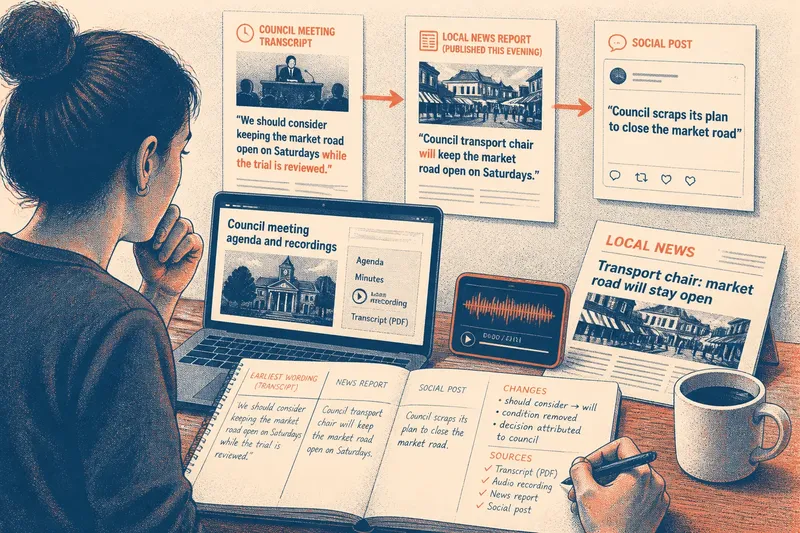
Rewrite the main assertion in a plain sentence before judging its support. Keep its subject, action, timeframe and scope, while stripping away dramatic phrasing. “Officials considered a change” is not the same as “officials adopted the change”; “some residents reported delays” does not establish that every service was delayed.
Pay attention to words that strengthen a claim: “caused”, “proved”, “admitted”, “widespread” and “unprecedented”. Ask what would need to be true for each word to fit. If a story contains several assertions, identify the one carrying its main point rather than getting sidetracked by an easier detail.
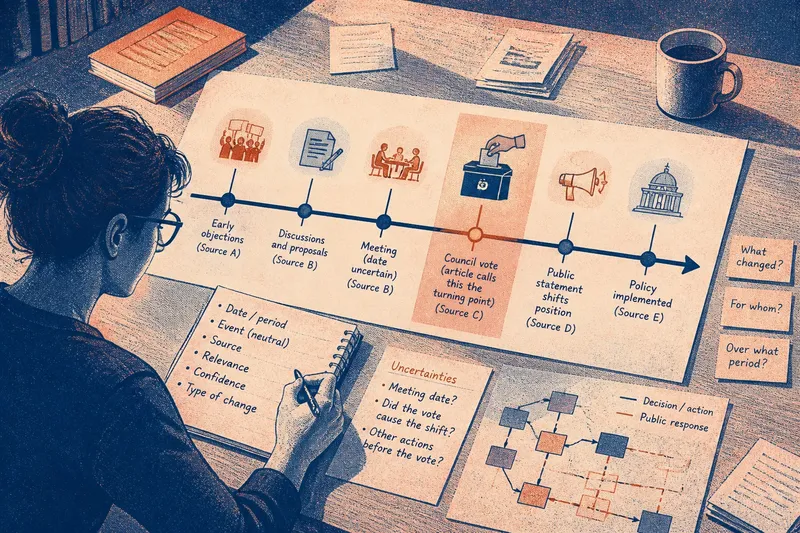
A claim is easier to assess when you can say who did what, where and during which period. If those boundaries are missing, the wording may be broader than the evidence can sensibly address.
How can you trace the step from evidence to claim?
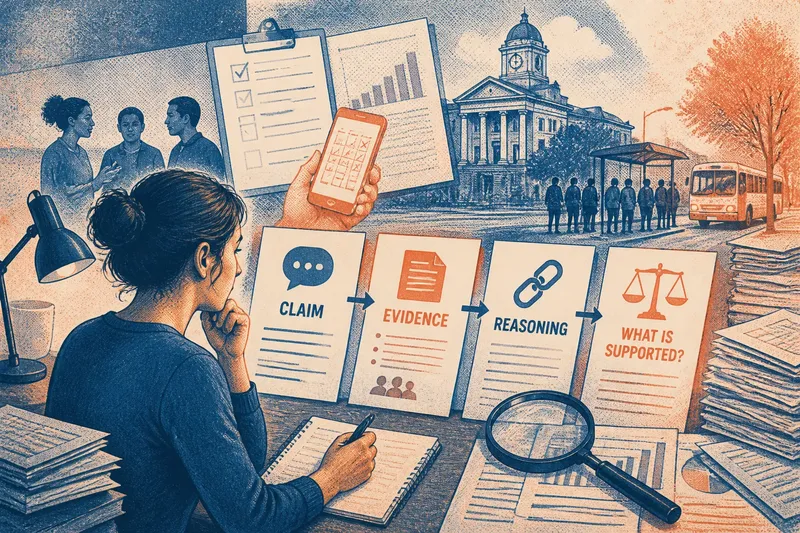
Use a claim–evidence–reasoning map to make the article’s argument visible. Note the assertion, the material offered in support, and the stated or unstated reason that links them. The third part is often where a plausible detail becomes a stronger conclusion.
Say you read an invented report claiming that a council’s new booking system caused longer waits. Its starting material is three residents’ accounts of trouble getting appointments; the action is to map the argument into claim, evidence and reasoning. The reasoning appears to be that these accounts reflect the system’s effect on the wider service. The observable result of the map is a clear distinction: the accounts support that those residents faced difficulty, but, on their own, do not establish the cause or the scale of the problem. You can then look for other evidence without treating the accounts as false.
Use the map to locate an inference, not to decide in advance that the story has got it wrong.
Does the evidence cover the same ground as the claim?
Compare the reach of the assertion with the reach of its supporting material. Ask who or what the evidence covers: one location, a particular group, a short period, or a selected set of cases? A report can make a valuable local observation while still overreaching if it presents that observation as a regional trend.
Look for boundary-setting phrases such as “among those interviewed”, “in this sample” or “in the district”. Their presence helps clarify what the reporting covers; their absence does not prove the claim false, but it can leave the scope unclear.
Choose a scope check when the main concern is a sweeping claim built from limited material. Keep that question separate from whether the evidence supports the claim’s reasoning.
What else could explain the same outcome?
For a cause-and-effect claim, ask whether another plausible factor could account for the evidence. A before-and-after sequence may fit a causal explanation, but timing alone does not rule out other changes happening at the same time.
Keep this check focused. If a story says a new rule led to longer waits, a relevant alternative might be a simultaneous rise in demand or a change in how delays were recorded. Ask whether the article addresses that possibility; do not pile up remote scenarios simply to make a conclusion impossible to assess.
When a report considers credible alternatives, its reasoning is clearer, even if some uncertainty remains.
What questions help separate a claim from its support?
What counts as evidence in a news story?
Evidence is material offered in support of an assertion, such as a record, direct observation, testimony, dataset or attributed statement. Its form alone does not determine what it establishes: a written proposal can show that an idea was recorded without showing that it was approved or put into effect.
Can an accurate detail fail to support a headline?
Yes. A detail may be accurate yet too narrow, indirect or unrelated to establish the headline’s stronger wording. Ask what it demonstrates by itself, then compare that with the claim readers are being asked to accept.
What if the article leaves the reasoning unstated?
Name the missing link in ordinary language: perhaps the story assumes that sequence proves cause, or that selected accounts represent a larger group. Treat the conclusion as less established than the evidence itself rather than supplying your own guess.
How should uncertainty affect your reading?
Separate what is supported from what remains open. You might accept that an event occurred while staying unsure about its cause or scale; that distinction preserves the supported part without presenting the unresolved part as settled.
Which check fits the story?
Choose the check that targets the main gap in the argument. These observations and decisions can help you make that choice:
- Observation: You can state the assertion, but the article’s logic is hard to follow. If the evidence is clear but the link is missing, then map claim, evidence and reasoning; otherwise, use the scope or alternative-explanation check that better fits the gap.
- Observation: The headline describes a whole region, while the cited material concerns one district. If the report does not explain how that district represents the region, then treat the broad reach as unresolved; otherwise, check whether the stated basis for generalising fits the claim.
- Observation: A report says an action produced an outcome and relies on a before-and-after sequence. If other changes could have happened alongside it, then check whether the article addresses them; otherwise, note that the sequence supports timing but still inspect the causal reasoning.
- Observation: A document records that officials discussed a proposal. If the story says the proposal was adopted, then look for evidence of approval or implementation; otherwise, keep the conclusion limited to the discussion the document records.
- Observation: Interviews describe repeated problems among a selected group. If the story claims the problems affect everyone, then look for evidence covering a broader group; otherwise, retain the reported experiences while keeping their wider prevalence open.
- Observation: The article distinguishes verified events from reported experiences and notes gaps in its account. If those limits are visible, then preserve the distinction when describing the story; otherwise, avoid treating an unqualified conclusion as more settled than its evidence allows.
Some stories need more than one check. A report might attribute a regional trend to a new rule while relying on a small set of local accounts. Ask separately whether those accounts establish the trend’s reach and whether the rule is shown to have caused it. One limitation does not answer the other.
What can you say when the evidence is mixed?
Describe supported and unresolved parts separately. A report may establish that a decision was made, offer suggestive evidence about its effects and leave the scale of those effects unclear. That is more precise than calling the entire story either true or false.
Look for qualifications, counterexamples, gaps in records and distinctions between reported experience and verified outcome. If an article revises its account as more information becomes available, consider what changed and why; a revision alone does not show that the earlier version was dishonest.
As a final check, complete two sentences: “The evidence supports…” and “It does not yet establish…”. For a claim-and-evidence story, that small exercise helps keep the conclusion within the material’s limits—and makes clear what information would be needed to go further.