Reading an Early Account Without Filling the Gaps
Reading an early account carefully helps you track what may change, preserve update notes and avoid carrying yesterday’s wording into today’s decisions.
The common mistake with an unfolding story is to keep reading the first version as if nothing has changed. That can leave you repeating a corrected detail or missing a fresh caveat. Reading an early account carefully means treating it as a dated snapshot, then checking what the newsroom has altered and why.
What does an update actually change?
An update can add information, correct an earlier detail, clarify wording or report that a question remains unanswered. Those are different editorial actions. A newly added paragraph is not necessarily a correction, and a correction does not automatically settle every part of the story.
Look for the update note, publication time and any correction notice. Then compare the relevant passage with the earlier wording if it is available. Ask what changed, what prompted the change and whether the headline has caught up.
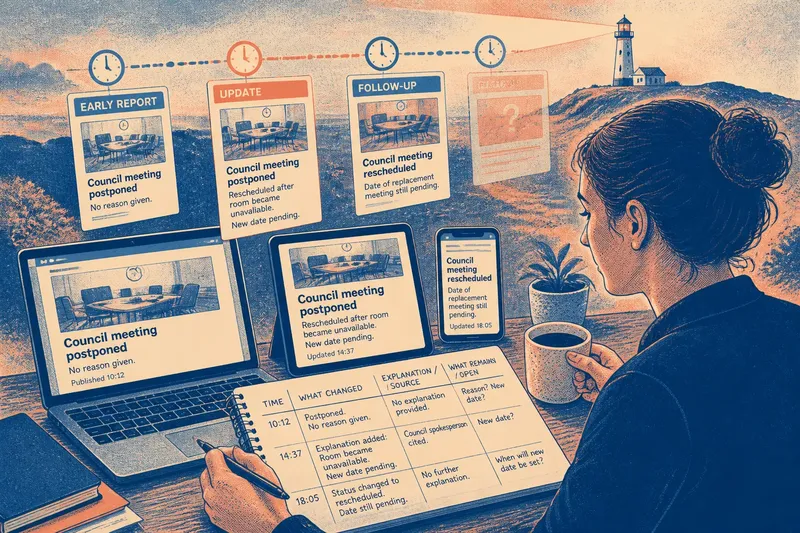
Keep a compact record with three fields: the point now reported, what changed, and what remains open. This makes later revisions easier to follow without turning the story into a tidy narrative that the reporting has not established.
How can I keep track of a changing report?
Use a simple revision log rather than relying on memory. For each visit, note the time shown on the article, the sentence or detail that changed, and the explanation given by the publisher. If no explanation appears, record that too instead of guessing why the wording shifted.
- Check the publication and update times; if the story has a newer timestamp, read the changed sections before sharing it, otherwise treat your copy as the version you saw at that time.
- Look for a correction or editor’s note; if it identifies a specific error, replace that detail in your notes, otherwise do not assume a silent wording change is a formal correction.
- Compare the headline with the current article text; if the headline still makes a stronger claim, repeat only the narrower wording supported in the text, otherwise use the headline as a quick description rather than a substitute for the report.
- Check whether a new passage names its source; if it adds a distinct source or document, record what that source contributes, otherwise mark the passage as added context rather than independent confirmation.
- Find out whether an earlier claim has been withdrawn or qualified; if it has, remove or narrow it in your retelling, otherwise keep its original attribution visible.
- Check whether the update answers one of your recorded questions; if it does, note the answer and its stated basis, otherwise leave the question open and avoid filling the gap.
Say you read a local report saying a council meeting has been postponed, with no reason given. On your return, the update says the council has rescheduled it after a room became unavailable, while the date of the replacement meeting is still pending. Your log would record the new explanation, the source if the article names one, and the unresolved date; it would not turn the postponement into a claim about why the meeting was originally planned.
What should I do when a report quietly changes?
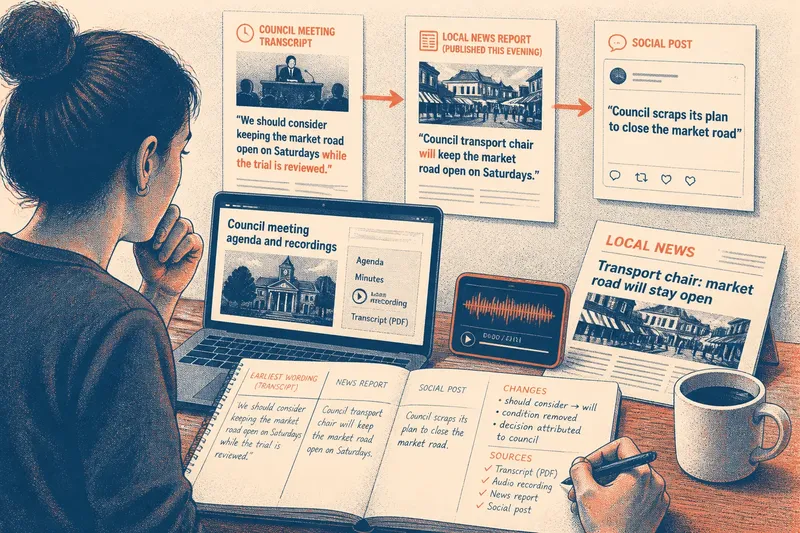
Read the passage around the edit, not just the latest headline. A small change from “will” to “may”, for example, alters the status of a plan; a changed name or date may correct a concrete detail. The words around an edit often show whether the report has become more precise or less certain.
If the publisher provides a version history, use it to identify the change. If not, compare a saved link, notification or your own dated note with the current text. Be cautious: a remembered impression is not a reliable record of the earlier wording.
When you cannot tell what changed, do not describe the edit as a correction or concealment. Say only that the current version differs from the version you noted, and seek an explanation from the publisher if that distinction matters.
Why can the same story look different across outlets?
Newsrooms may update at different times, rely on different source material or choose different levels of detail. One report may incorporate a new statement while another still reflects an earlier account. Compare timestamps and update notes before treating variation as a substantive disagreement.
Check whether the outlets are reporting distinct information or repeating the same original statement. If one article adds a document or a named source, note that specific contribution. If several articles use identical wording without showing separate reporting, repetition alone does not tell you that the detail has been independently checked.
When versions conflict, keep the conflict visible. Record what each current report says and the time attached to it; do not blend them into a single account simply because that feels more complete.
Which questions help with reading an early account?
How often should I check for updates?
Return when the story signals that a relevant decision or statement is pending, or when a change could affect what you need to do. Otherwise, a specific reason to check is more useful than refreshing repeatedly.
Should I trust the newest version automatically?
The newest version is the current account from that publisher, not proof that every point is settled. Read its update note and attribution, and keep any remaining uncertainty attached to the detail.
What if there is no update note?
Use the article’s visible timestamps and compare the wording you can verify. If the change’s cause is unclear, record that uncertainty rather than assigning a motive or calling it a correction.
Can I share an older link?
Check whether the link now opens the revised article and whether your own description matches its current wording. If you are discussing an earlier version, say so plainly and identify the wording or time you mean.
When should an early account affect a decision?
If the story concerns travel, public services or another immediate practical matter, use the relevant organisation’s current notice for operational guidance. A news report can provide context, but it may not reflect the latest instructions. For matters involving health, legal rights or safety, seek advice from an appropriately qualified professional where needed.
For ordinary reading, the useful habit is to keep the revision trail attached to the story: what the publisher changed, what basis it gave and what remains unresolved. Reading an early account carefully is less about predicting the next update than knowing when your understanding depends on an older version.